
If your windows or doors are drafty, foggy between the panes, hard to open, or simply worn out, it’s probably time to replace them. New, energy-efficient windows and doors make a home more comfortable, quieter, and cheaper to heat and cool, and a good install is what makes all of that last. Iowa Window & Door is a local Granger-based team serving the Des Moines metro. We install ProVia windows and doors built for Iowa weather; we keep things honest and pressure-free, and the first step is always a free estimate.
Replacing your windows and doors should feel easy and comfortable from the very first conversation: clear answers, a fair price, and the room to decide on your own time. That’s the experience we love giving homeowners, and this guide is here to make it even simpler for you.
Think of this as the guide we’d want our own family to have: warm, plain-language answers to the questions that naturally come up. We’ll cover the signs it’s time to replace, how to tell whether to repair or replace, the difference between insert and full-frame replacement, the window and door styles that work well on Iowa homes, how to think about ProVia and your options, what energy efficiency really does for your comfort and your bills, what a project costs and how financing works, and exactly what to expect from start to finish. By the end, you’ll know enough to make a confident decision, whether you call us or not.
A quick hello first. We’re Iowa Window & Door, a local team based in Granger that installs ProVia windows and doors across the Des Moines metro: Des Moines, Waukee, Ankeny, Urbandale, Johnston, Clive, and West Des Moines. Our crews have been installing windows and doors for over 15 years; our turnaround is currently quick (often about 4 to 6 weeks from the day you sign), and our whole approach is built around treating you the way we’d want to be treated. Now, let’s get into it.
What New Windows and Doors Do for Your Home Every Day
New windows and doors do quiet, wonderful things for a home, every single day. A living room that stays warm in January and cool in July. A back door that seals out the breeze. A bedroom that finally holds its temperature. And an energy bill that reflects all of it. When your windows and doors are doing their job well, you simply feel comfortable and barely think about them, which is exactly the point.
In many Des Moines metro homes, especially those built 20 or more years ago, the original windows and doors have reached the end of their useful life. Over time, seals loosen, and frames let a little air through, and older glass holds your heated and cooled air less effectively than today’s energy-efficient options. Upgrading them is one of the most satisfying improvements you can make, because you feel the difference right away and keep feeling it for years.
There’s no rush and no pressure here. Replacing your windows and doors is one of those upgrades that pays you back every day, in comfort, in quiet, and on your utility bill. And the first step is the easiest one of all: a free, friendly estimate whenever you’re ready.
And the benefits aren’t only for winter. In the Iowa summer heat, energy-efficient windows and doors keep your cool air inside and the sun’s heat out, so your home stays comfortable and your air conditioner gets a real break. Whatever the season, new windows and doors work in your favor, every single day.
The Signs It’s Time to Replace Your Windows and Doors
Your home gives you helpful clues when it’s ready for new windows and doors. Here are the signs worth keeping an eye on.
- You feel a draft. Stand near a closed window or door on a cold, windy day. If you feel air moving, the seal or the frame is letting your comfort leak right out.
- There’s fog or moisture between the panes. Condensation trapped inside the glass means the seal has failed, and that window has lost much of its insulating value.
- They stick, stiffen, or won’t stay open. Windows that fight you, or doors that drag and won’t latch right, are usually past the point of a quick fix.
- Your energy bills keep climbing. When your furnace and air conditioner run harder to keep up, inefficient windows and doors are often a big part of why.
- You see rot, soft spots, or daylight. Soft frames, peeling, water stains, or a sliver of daylight around a door are clear signs it’s time.
- The street is loud inside. Modern, well-sealed windows cut outside noise noticeably. If you hear every car go by, your windows aren’t doing their job.
- Some rooms bake all afternoon. If a west or south-facing room is hot all summer no matter how hard the AC works, your windows are letting solar heat pour straight in.
- They just look tired. Sometimes the windows and doors work well enough, but they date the whole house. New ones are one of the biggest curb-appeal upgrades you can make.
If you nodded along to even two or three of those, it’s worth a closer look. You don’t have to decide anything today. A free estimate gives you real answers about your specific home, with zero obligation to do a thing.
Should You Repair or Replace?
Not every problem means full replacement, and we’ll always tell you the truth about that. A single broken sash lock, a torn screen, or a bit of weatherstripping can sometimes be repaired, and if that’s genuinely the smarter move for you, we’ll say so.
That said, repairs have a ceiling. Once a window’s seal has failed and it’s fogging up, once the frame is warped or rotting, or once you’re patching the same drafty door for the third winter in a row, you’re usually pouring money into something that’s only going to keep declining. Replacement costs more up front, but it solves the comfort and efficiency problem for good, and it comes with a warranty behind it. A good rule of thumb: if the issue is cosmetic or tiny, repair it. If it’s about air, water, function, or efficiency, replacement almost always makes more sense over the life of the home.
The honest answer for your house depends on what we find when we look. That’s exactly what the free estimate is for: an experienced set of eyes telling you what’s actually worth doing, not what’s most expensive.
Insert vs. Full-Frame Replacement, and Which One Fits Your Home
When you start getting quotes, you’ll hear two phrases: insert replacement and full-frame replacement. They’re not interchangeable, and knowing the difference helps you understand your estimate.
An insert replacement fits a new window into your existing, sound frame. It keeps your interior and exterior trim intact, it’s less invasive, and it usually costs less. When your current frames are still solid, this is often the right, efficient choice.
A full-frame replacement removes the window all the way down to the rough opening, frame and all. It’s the right call when frames are rotted or soft from moisture, or when you want to change the size or style of an opening. It costs more because it’s more work, but sometimes it’s the only way to do the job correctly.
The good news is you don’t have to sort this out alone. We inspect every opening, show you the real condition of your frames, and recommend the approach that fits your home and your budget. Many homes use a mix of both, and that’s perfectly normal.
The Window Styles That Work Well on Iowa Homes
Replacement windows aren’t one-size-fits-all. The right style depends on the room, the look you’re after, and how you want the window to open. Here are the styles we install most across the metro.
Double-hung and single-hung
The classic, and for good reason. Both sashes tilt in on a double-hung for easy cleaning, they suit almost any home, and they’re a reliable, timeless choice for bedrooms, living rooms, and just about everywhere else.
Casement and awning
Casements crank open to the side and seal tight against Iowa wind, which makes them excellent for energy efficiency. Awnings hinge at the top and can stay open during a light rain, which is handy over a kitchen sink or in a bathroom.
Bay and bow
Want to add space, light, and a little drama to a room? Bay and bow windows project outward and create a bright focal point, perfect for a living room or a dining nook.
Picture, garden, and hopper
Picture windows are big, fixed panes that flood a room with light and views. Garden windows create a small greenhouse shelf, great for herbs over the sink. Hopper windows are a smart fit for basements. There’s a right style for every opening in your home, and we’ll help you match them.
Choosing the Right Doors: Entry, Patio, and Storm
Doors do more heavy lifting than people realize. The right ones boost your curb appeal, your security, your energy efficiency, and the way your home feels every time you walk in. Here’s how to think about the main types.
An entry door is the face of your home and your first line of defense against the weather. A new one looks fantastic, seals out drafts, and adds real security. ProVia entry doors come in styles and finishes to match any home, from classic to modern.
Patio doors open your home to the backyard. Sliding patio doors are sleek and space-saving; hinged patio doors and French doors make a wider, more elegant statement, and all of them can be built for energy efficiency so you’re not heating the deck all winter. Storm doors add another layer of protection and let you bring in a breeze on a nice day while keeping the bugs out. Whatever the door, the same rule applies as with windows: the product matters, and the install matters just as much.
Summer makes the case for doors especially well. A good patio door turns your backyard into part of the house for cookouts and long July evenings, and the right glass keeps the late-day sun from cooking the living room. A storm door lets you swap the solid door for a screen and pull a cool evening breeze through the house, then seal everything up tight again when the heat or the next thunderstorm rolls in. Small changes, big difference in how summer actually feels indoors.
ProVia, Pella, and Honest Help Choosing What Fits
One of the most common questions we get is simply, which brand should I choose? Here’s our honest take, without the sales spin.
We install ProVia, and we’re glad we do. ProVia is built to handle Iowa’s brutal swings from January cold to August heat; it delivers strong energy efficiency, and it’s backed by a limited lifetime warranty, which is meaningfully better than the prorated coverage you’ll often find at the big-box stores. For most homeowners, ProVia hits the sweet spot: high quality, genuinely durable, and a more economical investment than the premium national names.
For homeowners who want a premium option, Pella is a name many Iowans know and love, and it can be a great fit depending on your goals and budget. Our job isn’t to push you toward the priciest badge. It’s to understand what you care about, comfort, looks, longevity, budget, and help you choose the option that genuinely fits. That’s the whole point of an honest, no-pressure consultation: you get a real recommendation, and the final call is always yours.
Note for the team: confirm current ProVia and Pella positioning with the client before publishing, per the strategist note. Lead with ProVia.
What ProVia’s Limited Lifetime Warranty Means for You
A warranty tells you how much a company believes in what it sells, so it’s worth understanding. ProVia windows and doors come with a limited lifetime warranty, which is a meaningful step above the prorated coverage you’ll often run into at the big-box stores. Prorated coverage shrinks over time, paying you back less and less the longer you own the product, right when you’d most want it to hold up. A strong limited lifetime warranty is built to stand behind the product for the long haul instead.
In plain terms, that means more peace of mind. You’re investing in windows and doors you shouldn’t have to think about for a very long time, and that’s exactly the point. It also says something about the quality itself: a manufacturer doesn’t put a warranty like that on a product it expects to fail. We’ll walk you through the specific coverage in real, understandable language during your free estimate, so you know exactly what’s protected before you decide anything. No fine-print surprises.
Why Energy-Efficient Windows Matter So Much in Iowa
If there’s one place this upgrade earns its keep, it’s our weather. Iowa asks a lot of a window. Sub-zero wind chills and howling wind in winter, heavy heat and humidity in summer, and big temperature swings in between. Old, leaky windows and doors give up on all of it, which is why so many homes feel drafty in January and stuffy in July.
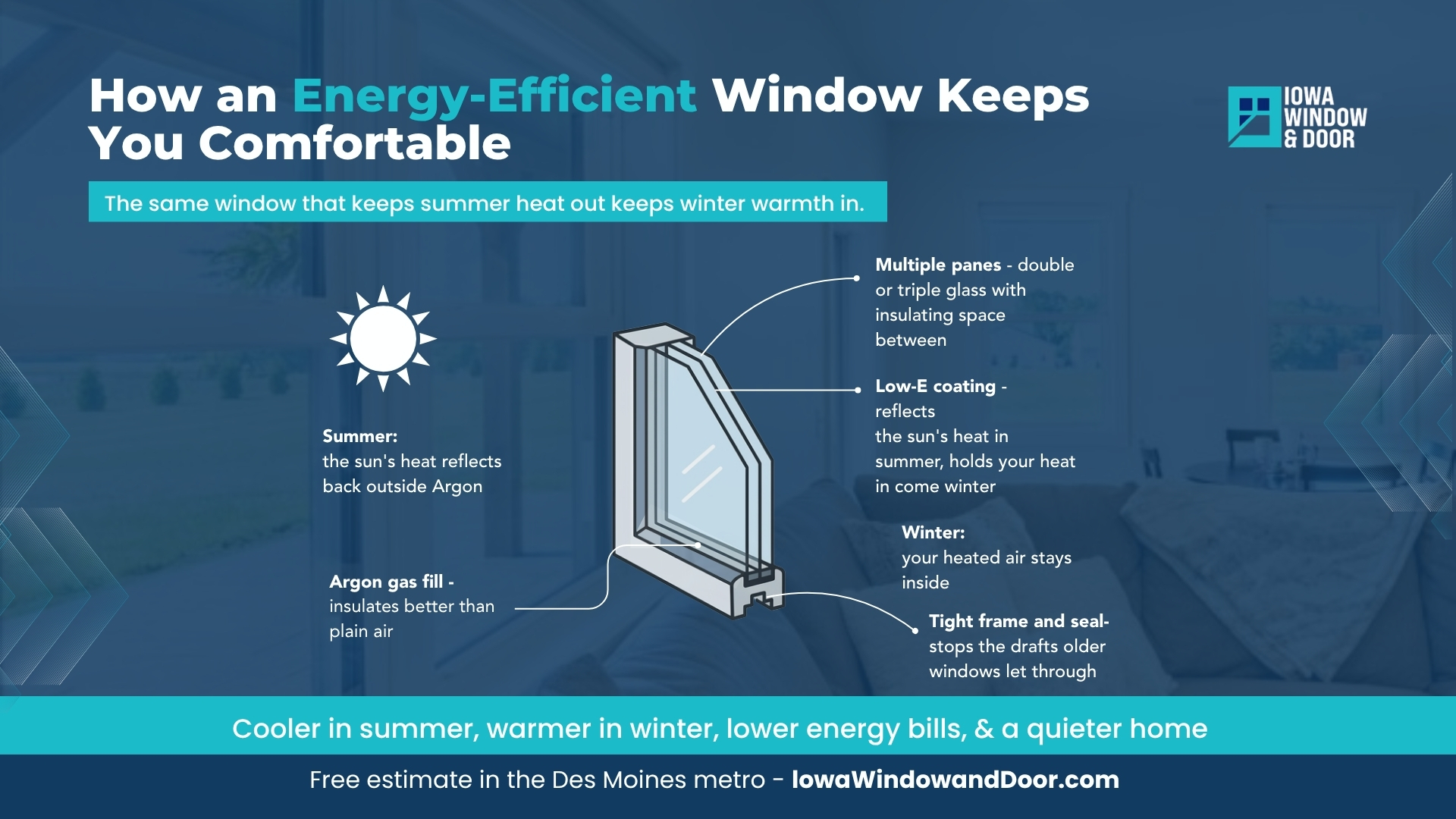
Energy-efficient windows fight back on every front. Modern multi-pane glass, low-emissivity coatings, insulating gas fills, and tight, well-built frames work together to keep your heated and cooled air inside where it belongs. The result you actually feel is a home that holds its temperature, fewer cold spots and hot spots, less strain on your furnace and air conditioner, and a noticeably quieter house. The result you see is on your utility bill.
For homeowners who want to push efficiency even further, a triple-pane upgrade adds another layer of insulation and noise reduction, which can be well worth it in our climate. We’ll walk you through the glass options in plain language during your free estimate, and if there’s a current upgrade offer running, we’ll let you know. You can also see real local projects in our project gallery to picture the difference on a home like yours.
What Actually Makes a Window Energy Efficient
If a window is going to keep you comfortable through an Iowa July and an Iowa January, a few things have to work together. None of it is complicated once someone explains it in plain language, so here’s the short version, no jargon for the sake of jargon.
The glass and the panes
Single-pane glass is basically a thin sheet between you and the weather, which is why old windows feel cold in winter and hot in summer. Modern windows use two panes, and triple-pane options add a third, with insulating space between them. More layers mean more insulation, a quieter room, and far less heat sneaking in or out.
Low-E coatings, the summer hero
A low-emissivity coating, usually shortened to Low-E, is a microscopically thin layer on the glass that reflects heat. In summer it bounces a big share of the sun’s heat back outside before it can bake your living room, and it blocks much of the ultraviolet light that fades your floors, furniture, and curtains over time. In winter it works in reverse and helps keep your heat inside. It’s invisible, and it does a lot of the quiet heavy lifting.
The gas fill
The space between the panes is often filled with an inert gas like argon, which insulates better than plain air. You’ll never see it or think about it, but it steadily improves how well the window holds your indoor temperature where you want it.
The frame and the seal
The best glass in the world won’t help if the frame leaks or the seal fails. Quality frames resist warping and seal tightly, which is a big part of why a properly built and installed ProVia window stops the drafts that older windows let through.
A quick word on the numbers
Two ratings are worth knowing. U-factor measures how well a window insulates, and a lower number is better. Solar heat gain coefficient, or SHGC, measures how much of the sun’s heat the window lets in, which makes a real difference for summer comfort in a bright, sun-facing room. At your free estimate, we’ll translate these into exactly what fits your home, your rooms, and the way the sun hits your house.
How Much Does Window and Door Replacement Cost?
The honest answer is that it depends, and you should be a little skeptical of anyone who throws out a price before they’ve seen your home. Cost comes down to a handful of real factors: how many windows or doors, the style and size of each opening, the glass and options you choose, and whether you need insert or full-frame replacement. A single patio door is a different project than a whole-home window replacement.
Here’s how we handle it: we measure every opening, talk through your options, and hand you a detailed, written, no-obligation estimate with an exact number. No vague ranges, no pressure, no price that mysteriously changes if you sign today. And because a quality upgrade is an investment, we offer financing for qualified homeowners so you can spread the cost into comfortable monthly payments. If there’s a current promotion running, like a special on a second window or a financing offer, we’ll make sure you know about it.
The point is simple: you’ll always know exactly what you’re paying and why, before you commit to anything. That clarity, by itself, is a big part of what makes the whole experience less stressful.
Will New Windows and Doors Pay for Themselves?
It’s a fair question, and the honest answer has a few parts. New, energy-efficient windows and doors cut the air leaks that make your furnace and air conditioner work overtime, so you’ll often see the difference on your bill, in summer cooling and winter heating alike. We won’t promise you a specific dollar figure, because every home, every utility rate, and every set of windows is different. What we can tell you is that stopping that waste adds up, month after month, year after year.
Then there’s the part that never shows up on a bill but matters just as much: comfort. A house that holds its temperature, rooms that stay comfortable in the afternoon sun, a living room you can fully enjoy on a 95-degree day, and a quieter house away from the street. That’s the kind of return you feel every single day.
New windows and doors are also one of the upgrades buyers notice and value, so they tend to hold their worth if you ever decide to sell. Add in financing that spreads the cost into comfortable monthly payments, plus a current offer when one’s running, and the math gets friendlier than you might think. We’ll lay it all out plainly at your free estimate so you can decide what makes sense for your home and your budget.
What to Expect: Our Simple, No-Pressure Process
A window or door project should feel organized and calm, not like running a gauntlet. Here’s exactly how ours works, start to finish.
- Step 1: The free consultation. We come out, listen to what’s bugging you, look at your windows and doors, answer every question, and share ideas. No pitch, no pressure.
- Step 2: A clear written estimate. We measure carefully and hand you a detailed quote with an exact price and your product options. You take all the time you need.
- Step 3: Installation. Once you’re ready, our crew handles everything, including complete removal and disposal of the old units, careful installation, full cleanup, and we walk the finished work with you. Most door installs wrap up in a single day, and window projects take anywhere from a day to a few, depending on the scope.
Currently, our turnaround runs about 4 to 6 weeks from the day you sign to the day we install, which is fast for this industry. We protect your home while we work, clean up completely when we’re done, and we don’t consider the job finished until you’re happy with it.
Installation Is Everything, and So Is the Crew
Here’s something the glossy ads won’t tell you: even the best window in the world will underperform if it’s installed poorly. Gaps, shims in the wrong place, sloppy sealing, a frame that’s not square- any of those will leave you with drafts and problems no matter how good the product is. Installation isn’t the boring part of the job. It’s the whole ballgame.
That’s why we’re so particular about our crews. Our installers have been doing this for over 15 years, and they genuinely care about the finished product. They show up on time, they explain what they’re doing, they’re patient with questions, and they treat your home with respect. When the last window is in, and the area is cleaned up, the work looks right because it was done right. That care is the difference between a window that performs for decades and one that disappoints in a season.
You don’t have to take our word for it. Our customer reviews are full of homeowners describing thorough, neat, on-time crews who answered their questions and left them with a home that felt new again. That’s the standard we hold every single job to.
How to Choose a Window and Door Installer
The company you hire matters as much as the product you pick, maybe more. Anyone can sell you a window, but the install, the service, and how you’re treated are what you’ll actually live with. Here’s what we’d tell a friend to look for, whether or not they end up choosing us.
- Local and accountable. A nearby team has its name on every job in the community and is easy to reach if you ever need them again.
- Experienced crews. Ask how long the people actually doing the install have been at it. Years on the job show up in the finished work.
- Honest, written pricing. You want an exact number in writing, not a vague range or a price that drops if you sign tonight.
- No pressure. A good company gives you room to decide. If a sales process feels like a trap, trust that feeling.
- Real reviews. Look for specifics about timelines, cleanup, and how questions were handled, beyond the star count.
We built Iowa Window & Door to check every one of those boxes: a local Granger-based team, crews with 15-plus years of experience, exact written prices, an honestly no-pressure process, and a wall of real customer reviews you can read for yourself. Hold any company you talk to, including us, to that standard.
Living With Your New Windows: Easy to Clean, Built to Last
One of the quiet pleasures of new windows is how little they ask of you. Many modern styles, like double-hung windows, tilt inward so you can clean both sides from inside the house, no ladder, no leaning out over the bushes. It’s a small thing that makes spring cleaning genuinely pleasant.
New windows and doors are also built to shrug off Iowa weather with very little upkeep. Quality frames don’t rot, peel, or need repainting the way old wood can, so seasonal maintenance mostly comes down to a quick wipe-down. And because ProVia windows and doors are backed by a limited lifetime warranty, you’ve got real peace of mind behind the product for the long haul.
In other words, you do this once and then you mostly just enjoy it: a cooler house in summer, a warmer one in winter, and windows that look and work great with almost no fuss. After installation, we’ll walk you through anything specific to your products, including how to register your warranty, so nothing’s left to guess.
The No-Pressure Difference
Buying new windows and doors should feel relaxed and straightforward, and that’s exactly the experience we’re built around. From your first call to the finished install, you get honest information, a fair and clear price, and all the room you need to decide.
If now’s the right time, wonderful. If you’d like to think it over, compare a few quotes, or talk it through with your family, that’s completely welcome, because it’s your home and your decision. We’d always rather earn your trust than rush you, and that’s a difference you’ll feel from the very first conversation.
The Best Time to Replace Your Windows and Doors
Since it’s summer as you’re reading this, let’s start there. A hot, humid Iowa summer is exactly when drafty, inefficient windows show their weakness: the AC strains, certain rooms never cool down, and the bill creeps up. Replacing now means relief during the hottest stretch, and a head start on comfort before the cold returns. Summer also brings steady, dry weather that’s friendly for installation, and getting on the schedule now beats the fall rush, when everyone suddenly remembers winter is coming.
There’s rarely a wrong time to do this, just a few things worth knowing. Fall is a favorite: new, tight-sealing windows installed before the deep Iowa cold mean a warm, comfortable winter. Spring and summer are wonderful for doors and for whole-home refreshes, and they give you plenty of time to enjoy the results before the next heating season.
The bigger point is that quality crews book up, especially heading into the busy seasons, so the real answer is to start the conversation a little earlier than you think you need to. Because our turnaround is currently quick, often about 4 to 6 weeks from signing, you have some flexibility, but planning means you get the timing you want. A free estimate now costs you nothing and tells you exactly where you stand, and you can always browse our recent projects while you think it over.
A Few Common Myths About Replacing Windows
A few common myths float around about replacing windows and doors. Here’s the reality behind the big ones.
Myth: It’s always wildly expensive.
It’s an investment, but it doesn’t have to break the bank. Insert replacement can lower the cost when your frames are sound, financing lets you spread it into monthly payments, and a current offer can stretch your budget further. And the money you save on energy bills and the comfort you gain every day are real returns.
Myth: It takes forever.
Not with us. Our turnaround is currently about 4 to 6 weeks from a signed contract, most door installs finish in a single day, and window projects usually take a day to a few. You won’t be living in a construction zone for months.
Myth: You have to do the whole house at once.
You don’t. You can start with the rooms that need it most, like a drafty bedroom or foggy front windows, and phase the rest over time. We’re happy to help you prioritize what’ll make the biggest difference first.
Myth: All windows are basically the same.
Far from it. Product quality, glass options, frame construction, and especially install quality vary enormously, and those differences are exactly what determine whether your windows are comfortable and efficient for decades or disappointing in a season.
Where to Start: A Room-by-Room Approach
If your whole house could use new windows but you’d like to start smaller, there’s a smart way to prioritize. Here’s how we’d help you think about it.
The rooms you actually live in
Start where you spend your time and feel the problem most: the living room, the kitchen, the primary bedroom. A drafty or sun-baked room you use every day is worth fixing first, because you’ll notice the comfort difference the moment it’s done.
The summer hot spots
Pay attention to west and south-facing rooms that overheat on summer afternoons. New energy-efficient glass with a Low-E coating makes the biggest, fastest comfort improvement exactly where the sun hits hardest, so those rooms are often a high-value place to begin right now.
The front of the house
If curb appeal is part of the goal, the windows and entry door facing the street do the most for how your home looks. Replacing those first gives you a visible refresh while you plan the rest.
The worst offenders
Any window that’s fogged between the panes, won’t open, or is visibly failing should move up the list, because it’s only going to get worse. We’ll help you rank everything during your free estimate and build a plan that fits your budget, this season and down the road.
Serving Des Moines and the Surrounding Communities
We’re a local team, based in Granger and proud to serve homeowners across the Des Moines metro: Des Moines, Waukee, Ankeny, Urbandale, Johnston, Clive, and West Des Moines, plus the surrounding communities in Central Iowa. When you call us, you’re working with neighbors, not a national call center, and you can learn more about our team any time.
Being local matters in this business. We know Iowa homes and Iowa weather; we’re easy to reach, and our name is attached to every project we do here. That accountability shows up in the work and in how we treat people. We’re not passing through. We’re building a reputation in our own community, one comfortable, well-installed home at a time.
Ready When You Are
If your windows or doors have been bugging you, this is your sign to at least find out what’s possible. There’s no commitment in a conversation, and a free estimate gives you real numbers and honest answers about your own home, with zero pressure to move forward until you’re ready.
When you’d like to take that first step, we’re here, and we’ll make it easy. You can reach us through our contact page or just give us a call.