TL;DR
A window energy label is issued by the National Fenestration Rating Council and carries five ratings: U-factor, solar heat gain coefficient (SHGC), visible transmittance, air leakage, and condensation resistance. U-factor measures heat escaping, so lower is better, and the scale runs from 0.20 to 1.20. SHGC measures solar heat coming in on a 0 to 1 scale.
Every ZIP code in Iowa sits in the ENERGY STAR Northern climate zone, where the Version 7.0 criteria ask for a window with a U-factor of 0.22 or lower paired with an SHGC of 0.17 or higher. Air leakage should read 0.3 or lower. The label rates the product only, never the crew that installs it.
What the Sticker on the Glass Is Actually Telling You
The National Fenestration Rating Council, usually shortened to NFRC, calls itself “the trusted, independent, nonprofit certification body for the energy performance of windows, doors, and skylights.” It does not make windows, and it does not sell them. It runs the rating system that lets a Marvin unit and a ProVia unit be compared on the same terms, tested as whole assemblies rather than as a pane of glass in isolation.
Five ratings appear on the label. Here is what each one covers, straight from the NFRC energy performance label definitions:
| Rating | What it measures | Scale | Which direction is better |
| U-Factor | “How well a product keeps heat from escaping a room” | 0.20 to 1.20 | Lower |
| Solar Heat Gain Coefficient | “How much solar heat a product allows in” | 0 to 1 | Depends on climate |
| Visible Transmittance | “How well a product lights your home with daylight” | 0 to 1 | Higher for daylight |
| Air Leakage | “How much air will enter a room through a product” | 0.3 or lower | Lower |
| Condensation Resistance | “A product’s resistance to condensation” | Higher score is better | Higher |
U-factor, the number people already know
U-factor is the rate of heat loss through the whole window assembly, frame included. It is the reciprocal of R-value, which is why the good numbers look small. A unit rated 0.20 loses heat at half the rate of a unit rated 0.40 under the same conditions.
Frame material, spacer type, the number of panes, the low-emissivity coating, and whether the cavity is filled with argon all move this figure. Two windows can both be double pane and land twenty points apart on U-factor, which is the difference between 0.20 and 0.40.
SHGC, the number people get wrong in cold climates
SHGC is the fraction of solar heat that gets through. A 0.30 rating means 30 percent of the sun’s heat reaches the room.
In Phoenix, you want that number on the floor. In Polk County, February sun landing on a south-facing living room is free heat you already paid the sun nothing for. The Department of Energy’s Building America Solution Center puts it plainly in its high-performance ENERGY STAR windows resource guide: the criteria run “higher SHGCs in colder climates and lower SHGCs in hotter climates.”
Visible transmittance and condensation resistance
Visible transmittance is daylight, not heat. Some low-E coatings that push U-factor down also drag VT down, and the difference between 0.55 and 0.40 is noticeable in a north-facing kitchen in January.
Condensation resistance is the underrated one here. It is scored higher-is-better, and it predicts how the window behaves when the inside is 70 degrees at 40 percent humidity and the outside is well below freezing. The 1991 to 2020 climate normals for Des Moines International Airport put the January average low at 13.8 degrees. That gap is exactly the condition that puts water on the bottom rail of an older window, and then black staining on the sash a few winters later.
air leakage
Air leakage is measured in cubic feet per minute per square foot of window. Building America notes that “most industry standards and building codes require an AL of 0.3 cfm/ft2 or less,” and the ENERGY STAR Version 7.0 criteria set the same 0.3 ceiling for windows, sliding doors, and skylights, with 0.5 allowed for swinging doors.
Some manufacturers leave this line blank. A blank air leakage line on a replacement window quote is worth a question.
What Numbers Should a Des Moines Window Hit?
For a home anywhere in Polk, Dallas, or Warren County, the target is a U-factor of 0.22 or lower and an SHGC of 0.17 or higher. Those are the prescriptive window criteria for the ENERGY STAR Northern climate zone under Version 7.0 of the residential windows, doors and skylights specification, which took effect October 23, 2023.
There is no ambiguity about which zone we are in. EPA publishes the zone assignment by ZIP code, and all 1,063 Iowa ZIP codes in that file are listed as Northern, including 50309 in Des Moines and 50265 and 50266 in West Des Moines. Northern maps to International Energy Conservation Code zones 5 through 8.
The Northern zone is also the only zone with a second route to certification. If a window cannot reach 0.22, it can still qualify by trading U-factor against solar gain:
| U-factor | Minimum SHGC required |
| 0.22 or lower | 0.17 |
| 0.23 | 0.35 |
| 0.24 | 0.35 |
| 0.25 | 0.40 |
| 0.26 | 0.40 |
Read that table for a second, and the design intent becomes obvious. A slightly leakier window is acceptable up north only if it is letting in a lot more winter sun to pay the difference back. That trade is not offered in the North-Central, South-Central, or Southern zones, and it is not offered on doors or skylights at all.
The SHGC Advice You Will Read Online Is Backwards Here
Search for window ratings and Iowa in the same sentence, and you will be told to look for an SHGC of 0.40 or lower, or 0.30 for “balanced” performance. One Iowa contractor guide published in February 2026 states that Northern zone windows must hit a U-factor of 0.30 or lower and an SHGC of 0.40 or lower.
Both halves of that are wrong under the current specification. The U-factor ceiling is 0.22, not 0.30. And the SHGC figure is a floor, not a ceiling: 0.17 or higher, with no upper limit at all. A homeowner who takes the 0.40-or-lower advice into a showroom is filtering out the windows the program actually wants in an Iowa wall.
Where does the confusion come from? Older ENERGY STAR versions, and southern-market advice copied north. Version 7.0 introduced a minimum SHGC for Northern zone windows. Anything written before late 2023, or written for a national audience, is likely still repeating the old shape of the rule.
The Label Rates the Window, Not the Hole It Goes Into
A 0.20 window installed out of square, shimmed hard against the jamb and foamed with whatever was in the truck will underperform a 0.27 window fitted properly. Nothing on the NFRC label captures that, because nothing on the NFRC label is measured in your house.
This is the part of the decision that quietly matters most, and it is why we walk every opening before quoting rather than pricing from a spreadsheet. It is also the honest answer to whether this is a weekend project: getting a modern window level, plumb, air-sealed at the rough opening, and correctly flashed at the sill is where the rated performance is either kept or thrown away. Building America is direct about the warranty exposure too, telling homeowners to “follow the manufacturer’s installation instructions when installing the windows to avoid voiding the warranty.” If you are weighing that up for your own house, our window & door Services in Des Moines, IA page lays out what each service actually includes.
The install method changes the picture as well. A pocket install, sold as an insert window replacement, keeps the existing frame and drops the new unit inside it, which preserves your interior casing but leaves the original rough opening insulation exactly as it was in 1954. A full frame window replacement takes everything back to the studs, which is the only version of this job where the cavity around the window gets re-insulated and re-flashed. Same NFRC numbers on the sticker, different result in February.
Does the Federal Tax Credit Still Cover Windows in 2026?
No. The 25C home improvement credit, worth 30 percent of cost up to $1,200 a year and claimable on windows, skylights and exterior doors, ran out at the end of last year. EPA states it flatly on the ENERGY STAR federal tax credits page: Through December 31, 2025, federal income tax credits are available to homeowners. Work placed in service in 2026 does not qualify.
We mention it because a lot of window content still leads with that credit, including national consumer articles last updated in 2023. If a salesperson tells you the federal government will hand back 30 percent of your window job this year, ask which code section they mean.
Utility and manufacturer promotions are a separate matter and change throughout the year. Those are worth asking about at quote time.
Two Labels, and Which One You Should Keep
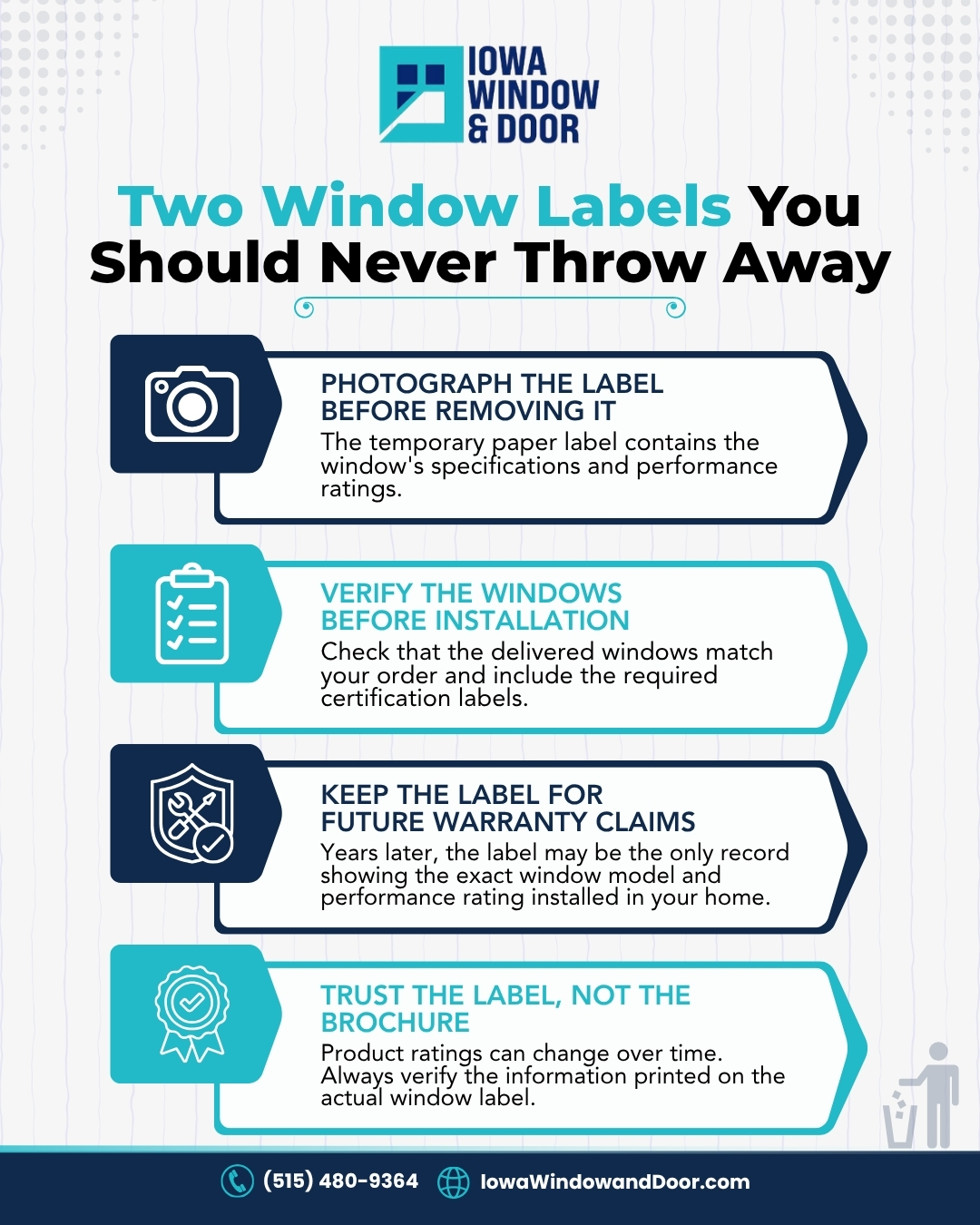
Windows arrive with a temporary paper label carrying the ratings and, where applicable, the ENERGY STAR mark. That is the one homeowners peel.
Do not peel it, or at least not before you photograph it. EPA’s advice to window buyers, on the ENERGY STAR high-performing windows and storm windows page, is that “the installer should be told explicitly to keep each window’s NFRC label for you (basically a big sticker) so you have an exact record of what was installed.” The same page tells homeowners to check, before a single old window comes out, that the units on the truck are the ones ordered and that they carry both labels. Warranty claims years later turn on knowing the exact unit and rating that went into that opening, and memory is not a record.
There is a maintenance angle behind the label too. Under Version 7.0, manufacturers recertify U-factor every five years and air leakage every ten, so a rating quoted from an old catalogue page is not automatically the rating on the unit being delivered this month. Ask for the label, not the brochure.
Doors Read Off a Different Chart
Entry doors are rated on glazing level rather than climate zone, which surprises people comparing a door quote to a window quote. Version 7.0 sets an opaque door at a U-factor of 0.17 or lower, a door up to half glass at 0.23 or lower with an SHGC of 0.23 or lower, and a door more than half glass at 0.26 or lower for the Northern and North-Central zones with an SHGC of 0.40 or lower.
That opaque figure of 0.17 is the tightest number in the whole specification, tighter than any window. It is also why swapping a 1970s hollow steel front door in Beaverdale for a foam-cored unit changes how the entry hall feels within a day. Sliding patio doors are rated as windows and carry the 0.3 air leakage ceiling; swinging doors get 0.5.
Skylights sit in their own row: 0.45 or lower in the Northern zone, with no SHGC requirement at all.
If you are pricing a front entry, the ProVia door installation page covers entry, patio, and storm door work, and the same label rules apply to every one of them.
Why Pre-Freeze Timing Changes What You Should Buy
Central Iowa gives you a narrow window for this work, and the calendar is not a marketing device.
Using the 1991 to 2020 NOAA normals for Des Moines International Airport, the normal daily low at the airport drops through 32 degrees on November 11. October 31 still averages 36.6 degrees overnight. The station’s annual heating degree day normal is 6,177.7, and January alone carries 1,321.9 of them. Roughly a fifth of the year’s total heating load lands in that one month.
Two practical consequences follow. Sealants and foams have application temperature ranges, and a crew working an open wall in late December is managing conditions rather than ignoring them, which is one reason full frame work gets scheduled earlier in the fall than insert work does. The second is simple arithmetic: a window installed in September earns its U-factor across all 6,177 degree days. The same window installed in February earns it across the tail.
Housing stock matters here too. Beaverdale bungalows and the older stock around Sherman Hill and South of Grand were built with wood frames that are often still sound, which is exactly the case where an insert makes sense. Post-war ranches in Urbandale and Clive that have already been through one aluminium retrofit are usually the opposite. Our 3-Step Window & Door Process starts with measuring the openings for that reason, since the frame condition decides the method before the label ever comes into play.
Reading a Real Label in Your Own Driveway This Fall
Next time a sample unit is in front of you, ignore the brochure and find the sticker. Five things, in order:
- U-factor first. Expect 0.22 or lower for a Northern zone window.
- SHGC second. Expect 0.17 or higher, not lower.
- Air leakage: 0.3 or better.
- Condensation resistance, if the house has had winter moisture trouble.
- Photograph the label before anyone peels it.
If the numbers on the quote in your hand do not match the numbers on the glass, that is the conversation to have before signing. We are happy to walk a label with you at the kitchen table, anywhere in the Des Moines metro we cover. Book a measure with Iowa Window and Door, and we will bring the actual spec sheets for the units we would put in your openings.