
A window earns the word “storm-resistant” in Des Moines through three things you can check before you sign anything: the wind and water rating printed on its certification label, the type and thickness of the glass in the sash, and how firmly the frame is fastened into the wall. Brochure adjectives do not count. The rating is a tested number, the glass is a line on the order, and the fastening is a decision made on install day.
TL;DR
Storm-resistant windows for a Des Moines house are defined by a certification label, not a marketing term. The North American fenestration standard rates every window for air leakage, water penetration, and structural wind load, then prints a single performance grade based on the weakest of the three. That grade is the number to compare.
The city of Des Moines adopted the 2024 International Residential Code effective January 1, 2026, and that code requires new exterior windows to carry this tested label. It does not require hurricane impact glass, because central Iowa is not a hurricane-prone region under the code’s own definition.
The August 10, 2020 derecho measured 75 mph at Des Moines International Airport. Glass choice (tempered or annealed, and its thickness) and fastening into the opening decide how a window behaves when a limb or hailstone arrives, and no standard window rating covers hail.
What Does Storm Resistant Actually Mean for a Des Moines Window?
For a house in Polk County, a storm-resistant window has been lab-tested to hold a stated wind pressure without failing, keeps water out at a stated pressure, and has been installed so that the wall, not just the window, carries that load. That is the whole definition that holds up. Everything else is a sales word.
The phrase gets used loosely around the metro, and it helps to separate three different products that people search for under it:
| What people mean | What it actually is | Does it apply in Des Moines? |
|---|---|---|
| A rated replacement window | A prime window tested and labeled for wind, water, and air | Yes, this is what the code expects |
| A storm window | A second, removable pane fitted outside or inside an older window | Sometimes, on older houses, but it is an add-on and not a replacement |
| An impact window | Glazing built for wind-borne debris in hurricane regions | Not required here; see the code section below |
Most of the confusion we hear at consults comes from mixing the first two. A storm window protects an old single-pane sash. A rated replacement window does that job itself.
What August 10, 2020 Put Against Metro Glass
Anyone choosing windows in Des Moines has a real storm to measure against, and the National Weather Service kept the numbers.
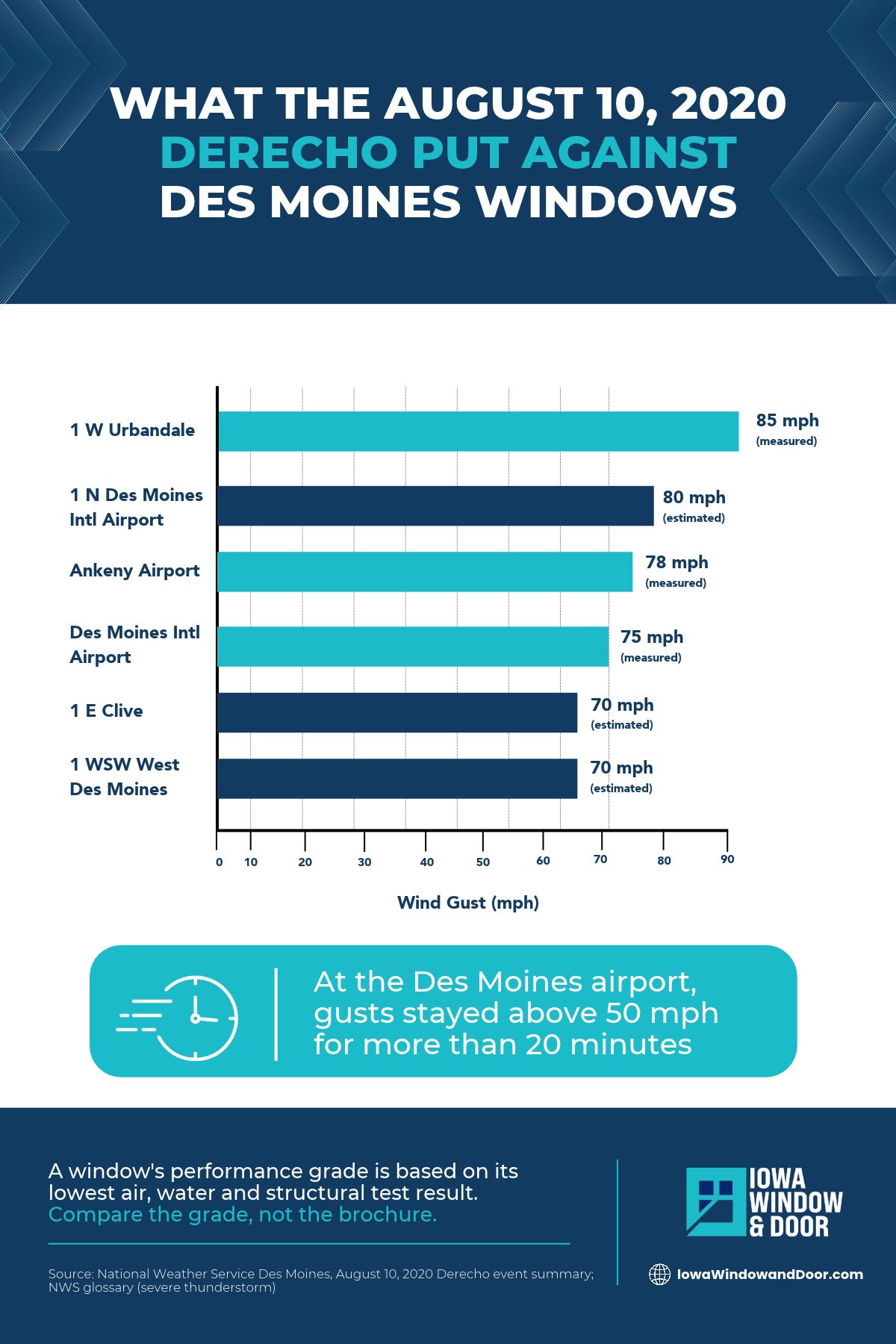
The National Weather Service Des Moines office summary of the August 10, 2020 derecho records a measured gust of 75 mph at Des Moines International Airport, with gusts over 50 mph lasting more than 20 minutes. The highest official gust in its area was 99 mph at the Marshalltown Airport. The office describes the strongest winds as falling between the Highway 30 and Interstate 80 corridor, and it names the Des Moines metro inside that band.
Here is what the same summary lists for towns we work in:
| Location in the NWS report | Gust | How it was recorded |
|---|---|---|
| 1 W Urbandale | 85 mph | Personal weather station, measured |
| 1 N Des Moines International Airport | 80 mph | Trained spotter, estimated |
| Ankeny Airport | 78 mph | Airport weather station, measured |
| Des Moines International Airport | 75 mph | Airport weather station, measured |
| 1 E Clive | 70 mph | NWS employee, estimated |
| 1 WSW West Des Moines | 70 mph | Trained spotter, estimated |
Read the damage reports underneath those gusts and a pattern shows up. The Grimes entry describes multiple large tree limbs down, the largest eight inches in diameter. Johnston logged an uprooted tree, Altoona logged branches down, and a fence blew over near 128th and Douglas in Urbandale. Most of what the report describes is wood moving through the air.
That matters for window buying. Pressure is only half of it. The other half is what hits the glass.
Why twenty minutes matters more than the peak
A single gust tests a window for a second. A derecho tests it for the length of the storm. Twenty minutes of gusts above 50 mph means the sash, the locks, and the seal around the frame are loaded and unloaded over and over, and wind-driven rain is pushed at the joints the whole time.
This is why the water part of a window’s rating deserves as much attention as the structural part.
The Sticker That Carries the Wind Rating
Every window that meets the North American Fenestration Standard, published as AAMA/WDMA/CSA 101/I.S.2/A440, carries a certification label with a short code on it. It is a different sticker from the energy label, and it answers a different question. If you have already read the energy label on the same window, this is its partner.
The standard sorts windows into four performance classes, written R, LC, CW, and AW. House windows are usually rated in the R class. After the class comes a performance grade, written PG, and a number.
The standard’s own definition is the key line: the performance grade is based on the lowest of the air, water, and structural results. A window cannot claim a high grade on strength while leaking at a lower pressure. The weakest result sets the number.
| Part of the label | What it tells you | Example from the standard |
|---|---|---|
| Class | The performance class the unit was tested in | R |
| Performance grade | The rating based on the lowest air, water, and structural result | PG25 |
| Size tested | The dimensions of the test unit | 30 x 60 in |
| Product type | The operating style tested | Casement |
| Design pressure (optional) | The structural pressure, stated in pounds per square foot | 60 psf in the standard’s secondary example |
The standard caps the grade at PG100 for the R, LC, and CW classes.
What to do with the number
Compare grades between quotes, not adjectives. Two windows can both be called storm-ready in a brochure while one carries a much higher grade than the other.
Check the tested size too. A rating earned by a small test unit is not automatically the rating of a much larger opening in your family room, and the label tells you what was actually tested.
Ask where the number comes from. The label names the manufacturer and the inspection agency, which is how you know an independent lab stood behind it.
Get the label data before the stickers come off
Certification stickers are meant to come off. Once they do, the rating lives only in paperwork. Ask for the class, grade, and tested size of every window style on the written quote itself, so the number that justified the price stays in your file.
That record is also useful later. If a storm does damage an opening in Urbandale or Johnston, the insurer and the next installer can see exactly what was there.
Does Des Moines Code Require Impact Windows?
No. The code in force in Des Moines requires tested and labeled windows, and it does not require impact glazing for a house in central Iowa. That answer comes from two public documents read together.
The first is the city’s own adoption notice. The list of adopted construction codes on the city’s own site states that, effective January 1, 2026, the 2024 International Residential Code is adopted by the city. Section R609.3 of that code says exterior windows and sliding doors shall be tested by an approved independent laboratory and bear a label identifying the manufacturer, performance characteristics, and approved inspection agency, to indicate compliance with the fenestration standard described above.
The second is the definition that governs impact protection. The code ties protection of glazed openings to wind-borne debris regions, and those sit inside hurricane-prone regions. Hurricane-prone regions are defined as the US Atlantic Ocean and Gulf of Mexico coasts where the basic wind speed for a typical house exceeds 115 mph, plus Hawaii, Puerto Rico, Guam, the Virgin Islands, and American Samoa. Des Moines is none of those.
So an “impact window” pitch in Ankeny or Norwalk is selling a coastal product, not meeting a local requirement.
Glass Choices That Change How a Window Fails
The rating tells you how much pressure a window holds. The glass decides what happens when something solid arrives.
We install ProVia, and the glass options are specified in the manufacturer’s own literature. The ProVia Endure window brochure lists the insulated glass pane thicknesses and which can be ordered tempered:
| Pane thickness | Tempered available | Annealed available |
|---|---|---|
| 2.5 mm (3/32 in) | No | Yes |
| 3 mm (1/8 in) | Yes | Yes |
| 5 mm (3/16 in) | Yes | Yes |
The same brochure says single, double, and triple strength glass options are available depending on the size of the window.
Annealed glass is ordinary glass, and when it breaks, it tends to leave large sharp pieces. Tempered glass is heat-treated and breaks into small granules. Neither one makes a pane unbreakable. The difference is the kind of mess and the kind of risk if a branch comes through a bedroom window at night.
Our practical view for metro houses: the windows most exposed to falling limbs, usually the elevation facing a mature tree line, and the large lower panes near where people sit, are the ones worth the tempered and heavier glass conversation. Nobody needs every pane in the house upgraded to answer a storm that hits one side.
Triple pane is an energy choice first
A triple pane unit adds a third layer of glass, and people sometimes assume that makes it a storm product. The reason to choose it in Iowa is heat loss. If storm behavior is the priority, the glass type and thickness in the outer pane is the conversation to have.
Where Hail Fits, and Where It Does Not
The honest answer is that the window rating does not address hail at all. The performance grade is built from air, water, and structural testing, and none of those is an impact test.
The National Weather Service classes a thunderstorm as severe when it produces winds of at least 58 mph or hail at least one inch in diameter, according to its public glossary. Central Iowa sees both.
- You can choose: glass type and thickness on the exposed elevations, and screens left in through storm season.
- You cannot buy: a window certified hail-proof. If a quote promises one, ask which standard it was tested to.
A Rating Only Holds If the Frame Is Fastened Right
A performance grade is earned by a window in a test chamber, clamped into a rigid test frame. In a house, the window is only as strong as its connection to the rough opening.
That is where the installation method comes into play. An insert replacement sets a new unit inside the existing frame, which keeps interior trim intact and suits openings whose original frame is square and sound. Taking the whole frame out, which is our full frame replacement, exposes the rough opening so we can see the framing, repair hidden damage, and fasten the new window straight into solid wood.
For storm purposes, the question to ask about each opening is simple: what is the new window being fastened to? If the answer is an old frame with soft sills, the rating on the new sticker is being asked to hold on through wood that might not.
On older homes in Beaverdale or near Ingersoll, we usually find a mix, with some frames that are perfectly good and some that are not. The decision is made opening by opening, and it is the part of a storm-resistant install you cannot see once the trim goes back on.
The entry side is its own job
Doors carry their own ratings and their own hardware. If your concern after a storm is the front entry, a rated storm door on the front entry protects the main door from wind-driven rain and gives it a second barrier. That is a separate conversation from the windows, and it is worth having at the same consult.
Questions to Bring to a Storm-Minded Window Consult
Bring this list and ask each installer the same questions, so the quotes can be compared on the same terms:
- Which performance class and grade is on the certification label for each window style you are quoting?
- How big was the tested unit, and are any of my openings much larger?
- Is the glass tempered or annealed, and what thickness is the outer pane on the side of the house facing the trees?
- For each opening, is this an insert or a full frame install, and why?
- Where will the new frame be fastened, and into how sound a surface?
- If you are recommending impact glass, what is it for, given the code here does not require it?
- Does the warranty say anything about glass broken by weather?
We answer all seven in writing. Carrying one product line is part of why we install only ProVia: the label data for every style is something our team already knows.
Book a Storm Season Window Consult Before Next Summer
The best time to decide on storm behavior is before the next severe-weather season, while there is time to walk every elevation and check every opening without a tarp over one of them. Walk the outside of your house and note which windows face the tree line, which are the largest, and which frames feel soft at the sill. That list is the start of the conversation.
When you are ready, Iowa Window and Door will measure each opening, show you the certification label for every window style we quote, and explain the glass and fastening choice for each one. Our shop is in Granger, and we cover the metro towns we work in, including Des Moines, West Des Moines, Urbandale, Johnston, Grimes, Waukee, Ankeny, Clive, Altoona, and Norwalk. Ask about ProVia window installation with the glass options specified for the exposed sides of your home.