
Almost every homeowner who calls us in October asks some version of the same question, and it is usually phrased as an apology. They know the drafty window needs doing, and they assume they have just missed the window of opportunity for the year.
TL;DR
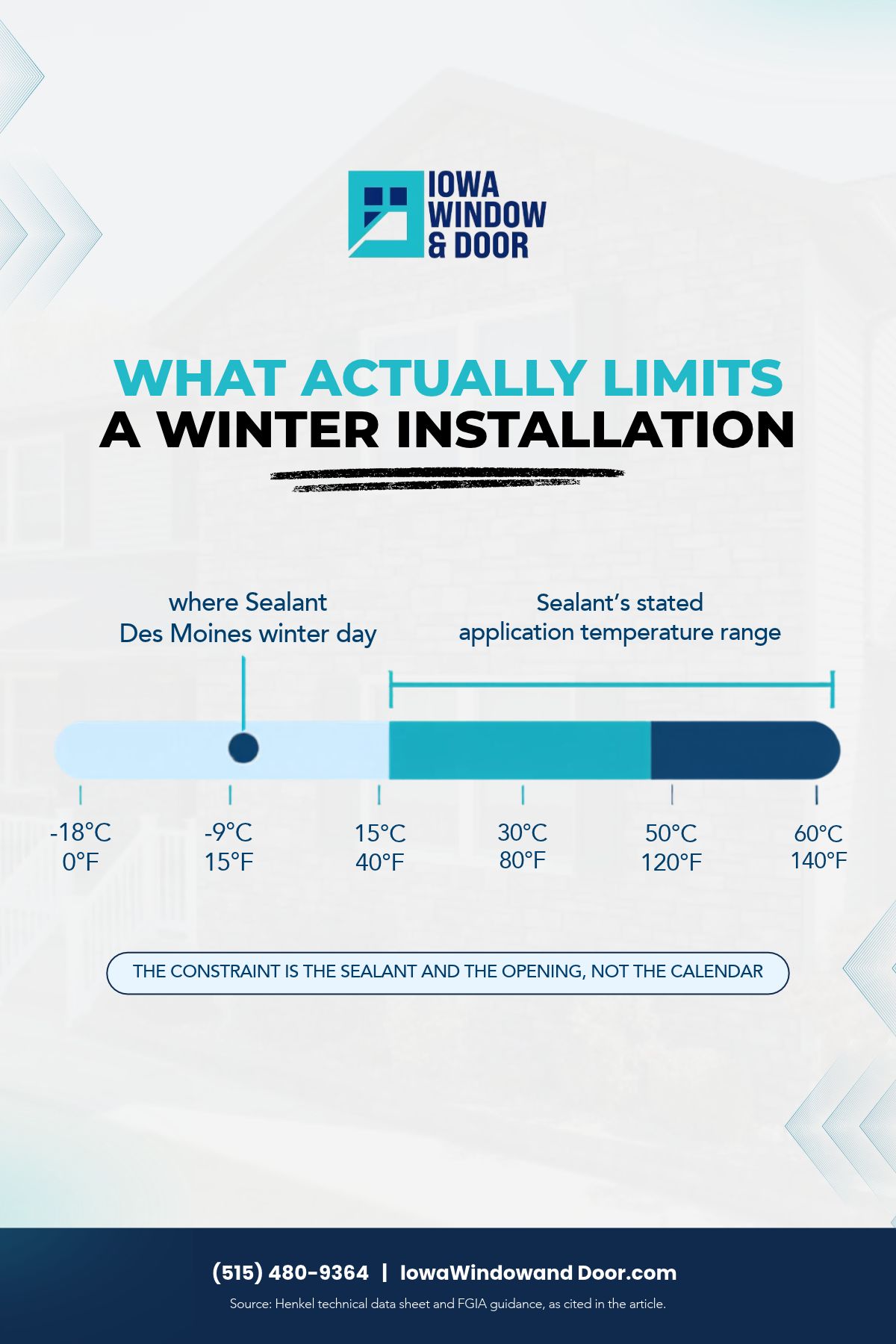
The objection is mostly wrong, and the reason is a number nobody quotes. The sealant we use around a replacement window is rated for application from 0 F upward, which is colder than most Des Moines working days all winter. Cold air is not what stops a January install.
What actually changes is narrower and more practical: frost on the opening has to be gone before anything is sealed, the sealant cures more slowly, the cartridge has to be warm before it will extrude properly, and the working gap between running the bead and setting the unit gets shorter than the crew is used to. The house also has to be managed differently, one opening at a time rather than a whole elevation open at once. Handled properly, a winter replacement is not a compromise, and it is the only time of year you can stand in front of the finished window and feel immediately whether the problem is solved.
Is It Too Cold to Replace a Window in Iowa?
Usually not, and the specification is public.
The sealant used to bed and seal a replacement window carries its own application range in the manufacturer’s technical data sheet, and those ranges are wider than people assume. The OSI QUAD MAX data sheet, one of the common sealants for this work, states that it can be applied between 0 F and 140 F. Its cured product then holds a service range from minus 14 F to 158 F with joint movement of plus or minus 50 percent, tested to ASTM C719. Those figures are published in Henkel’s technical data sheet for OSI QUAD MAX.
Read that against a Des Moines winter. Most working days between November and March sit comfortably above 0 F. The material is not the constraint that the conversation assumes it is.
What the same data sheet is strict about is the surface. It instructs that all surfaces be clean, dry, and free of contaminants, and it names the winter version of that requirement directly: remove any ice, snow, or frost present on substrates. That single line is the real difference between a summer install and a January one.
Why frost matters more than air temperature
Frost is not dirt. It is a layer of water sitting between the sealant and the wood or the sheathing it needs to grip. It disappears the moment a warm hand or a heat source touches it, which is exactly what makes it dangerous: the opening looks ready.
A crew that treats a frosted opening as a dry one gets a bead that looks perfect and is bonded to a surface that will be wet an hour later. The failure shows up as a draft in year two, and by then nobody connects it to the morning it was installed.
The Working Gap Gets Shorter
This is the part that separates a crew that has done winter work from one that has not, and it comes from two documents read together.
The fenestration industry’s installation standard, AAMA 2400-21, requires that the window be installed immediately after sealant application, before a skin forms or contamination collects on the sealant surface. The standard is published by the Fenestration and Glazing Industry Alliance, and it also sets the bead itself at a nominal three-eighths of an inch.
The sealant data sheet then tells you how long “before a skin forms” actually is. OSI lists skin formation at 17 to 20 minutes, measured at 72 F and 70 percent relative humidity, and it is explicit that cure time depends on temperature, humidity, and the depth of the bead.
| What the documents specify | Where it comes from |
| Set the unit before a skin forms | AAMA 2400-21 |
| Nominal 3/8 inch bead | AAMA 2400-21 |
| Skin forms in 17 to 20 minutes at 72 F | OSI QUAD MAX data sheet |
| Full cure: 24 to 72 hours, varying with temperature and humidity | OSI QUAD MAX data sheet |
| Applicable 0 F to 140 F | OSI QUAD MAX data sheet |
Those are two different documents describing one moment on site. The standard says to set it before the skin forms. The data sheet says the skin timing is a function of conditions. In cold, dry winter air, those conditions are not the 72 F and 70 percent humidity the number was measured at, which means the crew cannot work from a remembered timing. They run the bead and set the unit as a single continuous motion rather than prepping several openings and coming back.
That is a sequencing decision, and it is why winter installs go one opening at a time.
The cartridge has to be warm
A small detail with an outsized effect. The same data sheet advises storing the cartridge at room temperature for at least 24 hours before use so the sealant extrudes more easily at lower temperatures.
A cold cartridge fights the gun. The bead comes out thin in places and heavy in others, and a bead that is not continuous is not a seal. Cartridges live in the warm van or the house overnight, not on the truck bed.
How the House Is Managed, Not Just the Window
The technical limits are only half of it. The other half is that your house is briefly open to an Iowa winter, and a crew that plans for that is doing something visibly different from one that does not.
One opening at a time is the whole method. The old unit comes out, the new one goes in, and the opening is closed before anything else is touched. On a summer job, it is normal to pull several units at once and work along an elevation. In January, that turns a house into a wind tunnel and drops the interior temperature to the point where the sealant is working against the indoor conditions too.
Around that, the practical measures are ordinary and worth asking about. Interior protection goes up at the opening, and doors between the work area and the rest of the house stay closed.
The furnace stays running rather than turned down, and pets and small children are kept in a different room. None of it is exotic, and all of it is the difference between a comfortable day and a miserable one.
Our full sequence is set out in our process, and it does not change in winter so much as it tightens.
Insert or Full Frame Changes the Winter Answer
The two ways of replacing a window are not equally suited to a cold week, and this is the one place where the season should genuinely influence the decision.
An insert window replacement fits a new unit into the existing frame. The exterior envelope is disturbed far less, the opening is exposed for a shorter time, and less of the work depends on sealing to sheathing in the cold. It is the more natural winter choice when the existing frame is sound.
A full frame replacement takes the whole assembly back to the rough opening. It is the right call when the frame is rotted, or the opening needs to change, and it exposes more surface for longer. It is still entirely doable in winter, and it wants a milder stretch and a crew that has planned the sequence rather than a day chosen at random.
If the frame is sound and the goal is to stop a draft before February, the insert route is usually both the faster job and the lower-risk one in the cold. Which of the two a given opening needs is a site decision, not a catalogue one, and it is settled by looking at the frame.
The One Real Advantage of a Winter Replacement
Everything above is about managing a constraint. This part is the reason some people deliberately choose the off-season.
A window replaced in July is judged on how it looks. A window replaced in January is judged on whether the room is still cold, and you find out the same afternoon. The drafty window that prompted the call is being replaced in exactly the conditions that made it a problem, and the improvement is not a projection on a comparison chart; it is something you feel standing next to it.
That is also the honest reason we do not tell people to wait until spring. Waiting means another heating season with the problem, and it means the fix gets verified in June when nothing is being asked of it. Understanding the performance numbers on the sticker helps too, and we walk through those in how to read window labels.
For the opposite season, and it genuinely is a different job, we wrote a guide to replacing windows and doors in summer.
Why a New Window Can Show Condensation in January
This is the call we get a few weeks after a winter install, and it is worth answering here because the instinct is to assume the new window is faulty.
Condensation on the interior glass of a new window is usually a message about the room rather than a defect in the unit. Water vapour in the indoor air meets a surface that is colder than the air’s dew point, and it condenses there, in exactly the way it does on a cold drink in a warm kitchen. The window is simply the coldest surface in the room.
Two things make it more likely just after a replacement, and neither is a fault.
The first is that the house is now tighter. The old window was leaking air, and that leakage was carrying moisture out of the house without anybody noticing. Close that path, and the same daily moisture from cooking, showering, laundry, and breathing stays inside, where it has to go somewhere. A drier house was never the goal of the old window; it was a side effect of it not working.
The second is the season itself. Winter air held outside is dry, indoor air is not, and the gap between the two is widest in the coldest weeks. That is the same principle described in the sealant guidance above, where a substrate has to be dry rather than merely warm, applied to the room instead of the opening.
What to look at, in order:
- Where the moisture sits: On the room side of the glass points to indoor humidity. Between the panes points to the sealed unit and is a warranty question
- What the house is doing: Bathroom and kitchen extraction actually running, and vented outside rather than into an attic
- Whether it clears: Light morning condensation that burns off is different from standing water on the sill
Persistent moisture between the panes is the one to call about, and it is covered differently from the rest. Our warranty page sets out what applies.
What to Ask Before Booking a Cold Weather Install
| Ask | What a good answer sounds like |
| What is the sealant’s application range? | A named product and its published range, not “we watch the weather” |
| How do you handle frost in the opening? | A stated method for removing it and confirming the substrate is dry, not just warm |
| How many openings will be open at once? | One |
| Where have the cartridges been stored? | Somewhere warm, overnight |
| Insert or full frame, and why in winter? | A reason tied to the condition of the existing frame |
If the answer to the first question is a shrug, the crew is working from habit rather than from the data sheet, and habit is what fails in February.
Book the Window Replacement Before Another Heating Season
Cold weather does not disqualify a window replacement in Des Moines; it narrows how the day is run. If a window is costing you comfort now, that is an argument for doing it now rather than a reason to wait for April. Iowa Window and Door handles window replacement across central Iowa, and the frame condition that decides whether to insert against full frame is settled on site, in the service area we actually cover.